
If you’re shopping for a golf cart right now, the first question on your mind is probably pretty simple: what’s this going to cost me?
And the honest answer? It depends. A bare bones used gas cart can run as low as $2,000. A fully loaded, street legal electric model with a lithium battery pack can push past $25,000. That’s a massive range, and it can feel overwhelming if you don’t know what drives the price up or down.
This guide breaks down golf cart pricing for 2026 in plain terms. We’ll cover new vs used costs, electric vs gas price differences, what each major brand charges, and the hidden expenses most buyers don’t think about until after they’ve signed the paperwork.
Average Golf Cart Prices in 2026: What to Expect
Let’s start with the big picture. Here’s what you’re looking at across the main categories:
A basic new golf cart from a well known brand like EZGO or Club Car typically starts around $7,000 to $9,000 for a standard 2-seater. Move up to a 4-seater with some extra features, and you’re looking at $9,000 to $13,000.
New electric golf carts with lead-acid batteries fall in a similar range, roughly $8,000 to $12,000 for a solid 4-passenger model. But if you want lithium batteries (and honestly, most buyers in 2026 do), add another $1,500 to $4,000 on top of that.
Premium electric carts from brands like Evolution, Denago, and Club Car Onward with lithium power, street legal packages, and upgraded interiors can easily hit $14,000 to $20,000 or more.
Used golf carts? That’s where the deals are. A 3 to 5 year old electric cart in good condition typically sells for $4,000 to $9,000, depending on the brand, battery health, and overall condition. Older models (7+ years) can go for $2,000 to $4,000, though battery replacement costs can eat into those savings fast.
New Golf Cart Prices by Type: Gas vs Electric Cost Comparison
The gas vs electric question isn’t just about how the cart runs. It directly affects what you’ll pay upfront and over time.
Gas Golf Cart Pricing
Gas golf carts have traditionally been the cheaper option at the point of sale. A new gas cart from EZGO (the TXT series, for example) starts around $7,500 to $9,000. Club Car’s gas models fall in a similar range.
Gas carts appeal to buyers who need longer range without worrying about charge times. They also tend to be simpler mechanically, which means repair shops are familiar with them and parts are widely available.
That said, gas carts come with ongoing fuel costs (roughly $30 to $60 per month with regular use), more frequent oil changes, air filter replacements, and engine maintenance. Over a 5-year ownership period, those costs add up to roughly $2,000 to $4,000 more than an equivalent electric cart.
Electric Golf Cart Pricing
Electric carts have become the default choice for most buyers in 2026, and their pricing reflects the technology inside.
A new electric cart with traditional lead-acid batteries runs about $8,000 to $11,000. These batteries work fine, but they need regular watering, they’re heavy, and they usually last 4 to 6 years before needing a full replacement (which costs $800 to $1,500 for a complete set).
Lithium battery electric carts cost more upfront, usually $10,000 to $18,000 for new models. But lithium batteries last 8 to 10 years, charge in 2 to 4 hours instead of 8 to 12, weigh about 70% less, and need zero maintenance. When you factor in the longer battery life and lower maintenance costs, lithium actually saves most owners money over the full ownership period.
Monthly electricity cost for charging? About $10 to $25 depending on how often you drive and your local electric rates. That’s significantly cheaper than filling a gas tank.
Golf Cart Prices by Brand in 2026
Not all brands charge the same, and you’re not always paying for the same thing. Here’s how the major brands stack up on pricing:
Evolution Golf Cart Prices
Evolution has become one of the most popular brands in the market, especially for buyers who want modern features at a reasonable price. Their 2026 lineup starts around $9,500 for the Classic 2 (a 2-seater) and goes up to about $16,000 to $18,000 for the Forester 6 Plus (a lifted 6-seater with off-road styling).
Most Evolution models come with lithium batteries as standard, which is a big deal. Some competing brands still charge extra for the lithium upgrade. The Classic 4 Plus, which is their best seller, typically falls in the $12,000 to $14,000 range depending on the dealer and included features.
Denago Golf Cart Prices
Denago is a newer brand that’s been gaining ground quickly. Their pricing is competitive with Evolution, generally ranging from $10,000 to $16,000 for their main models. Denago carts tend to stand out on styling and tech features like digital displays and Bluetooth audio.
EZGO Golf Cart Prices
EZGO is one of the oldest names in the business, owned by Textron. Their carts range from about $7,500 for a basic TXT gas model to $14,000+ for a fully equipped Liberty LSV. The RXV series (their premium electric line) typically costs $10,000 to $13,000 with lead-acid batteries.
EZGO has the widest dealer and service network, which means parts are easy to find and resale values stay strong. That availability factor is worth considering when you’re comparing prices.
Club Car Golf Cart Prices
Club Car (owned by Platinum Equity) is another legacy brand with strong recognition. Their Onward series starts around $9,000 and can reach $15,000+ for customized builds. The Villager and Tempo models for commercial and fleet use fall in the $8,000 to $11,000 range.
Club Car tends to hold resale value well, which somewhat offsets the higher upfront cost.
Venom and Atlas Golf Cart Prices
These newer brands compete on price. Venom carts typically start around $7,000 to $10,000, while Atlas models range from $7,000 to $13,000. Both offer lithium battery options and street legal packages at price points below Evolution and Denago.
If budget is your primary concern and you’re comfortable with a less established brand, these are worth a look.
How Much Do Used Golf Carts Cost in 2026?
Used carts are where budget-conscious buyers can find real value, but you need to know what to look for.
Used Golf Cart Price Ranges by Age
A 1 to 3 year old used golf cart from a reputable brand typically costs 20% to 35% less than new. So a cart that was $14,000 new might sell for $9,000 to $11,000 used with low hours and good battery health.
Carts that are 4 to 6 years old drop more sharply, often selling for 40% to 55% off the original price. A $12,000 cart in this age range might go for $5,500 to $7,200. The catch? Batteries on lead-acid models in this age range are often near the end of their life, which means you could be looking at a $800 to $1,500 battery replacement soon after purchase.
Carts older than 7 years can be found for $2,000 to $4,500, but you’re buying a project at that point. Expect to spend on batteries, tires, seats, and possibly motor or controller work.
What Affects Used Golf Cart Prices
Battery condition is the single biggest factor. A used electric cart with brand new batteries is worth significantly more than one with old, tired cells. Always ask about battery age and, if possible, have them load-tested before buying.
Brand matters too. Used EZGO and Club Car models hold value better because parts are everywhere and mechanics know them inside out. Used carts from smaller or discontinued brands can be harder to resell later.
Cosmetic condition, tire tread, seat quality, and whether the cart has any upgrades (lift kit, custom wheels, LED lights, upgraded seats) all move the price up or down.
Street Legal Golf Cart Costs: What Extra Equipment Adds to the Price
If you want to drive your golf cart on public roads (and more buyers do every year), you’ll need a street legal or LSV (Low Speed Vehicle) configuration. This adds to the cost.
A factory street legal package typically adds $1,000 to $3,000 to the base price of a new cart. This includes headlights, tail lights, turn signals, mirrors, a windshield, seatbelts, a horn, and reflectors.
If you’re converting an existing golf cart to street legal, aftermarket kits run $200 to $600 for the equipment, plus $150 to $400 for professional installation. You’ll also need to budget for registration, titling, and insurance, which varies by state.
In Colorado, registering an LSV costs about $50 to $100, and liability insurance runs roughly $100 to $300 per year.
Hidden Golf Cart Costs Most Buyers Forget About
The sticker price is never the full story. Here are the costs that catch first-time buyers off guard:
Battery Replacement Costs
Lead-acid batteries need replacing every 4 to 6 years. A full set costs $800 to $1,500 including installation. Lithium batteries last longer (8 to 10 years) but cost $2,000 to $5,000 when they eventually need replacing.
This is the biggest hidden cost in golf cart ownership and the main reason lithium carts have a better total cost of ownership despite the higher purchase price.
Insurance Costs
If your cart is street legal, you’ll need liability insurance ($100 to $300 per year). Even for non-street-legal carts used on private property, some homeowners insurance policies cover them, but others don’t. Check your policy.
Full coverage insurance with theft and collision protection runs $200 to $500 per year.
Maintenance and Repair Costs
Electric carts are relatively cheap to maintain. Budget about $200 to $400 per year for tire checks, battery watering (lead-acid only), brake inspections, and minor electrical work.
Gas carts cost more in maintenance, roughly $300 to $600 per year for oil changes, spark plugs, air filters, fuel system cleaning, and belt replacements.
Charging and Fuel Costs
Electricity for an electric cart: about $10 to $25 per month with regular use.
Gas for a gas cart: about $30 to $60 per month, depending on fuel prices and how much you drive.
Registration, Titling, and Taxes
Sales tax on a golf cart purchase varies by state. In Colorado, you’ll pay state and local sales tax on the purchase price. Registration and titling for street legal carts adds another $50 to $100.
Accessories and Customization
It’s easy to spend $500 to $5,000 on accessories after buying a cart. Popular add-ons include custom seats ($300 to $800), lift kits ($200 to $1,500), upgraded wheels and tires ($400 to $1,200), LED light bars ($50 to $300), sound systems ($100 to $500), and rear cargo beds ($200 to $600).
Golf Cart Financing: Monthly Payment Estimates
Most golf cart dealers offer financing, and it makes higher-priced carts much more accessible. Here’s what typical monthly payments look like:
For a $10,000 cart with $1,000 down and a 48-month loan at 7.99% APR, your monthly payment would be about $220.
A $14,000 cart with $2,000 down and a 60-month loan at 6.99% APR comes out to roughly $237 per month.
Financing terms typically run 24 to 72 months, with interest rates ranging from about 4.99% for excellent credit to 19.99% for challenged credit. Some dealers work with lenders who specialize in recreational vehicle financing, which can sometimes get approvals that traditional banks won’t.
If your credit isn’t perfect, don’t count yourself out. Many dealers, including Lifestyle Golf Carts, work with financing partners who handle a range of credit situations.
How to Get the Best Price on a Golf Cart
A few practical tips that can save you real money:
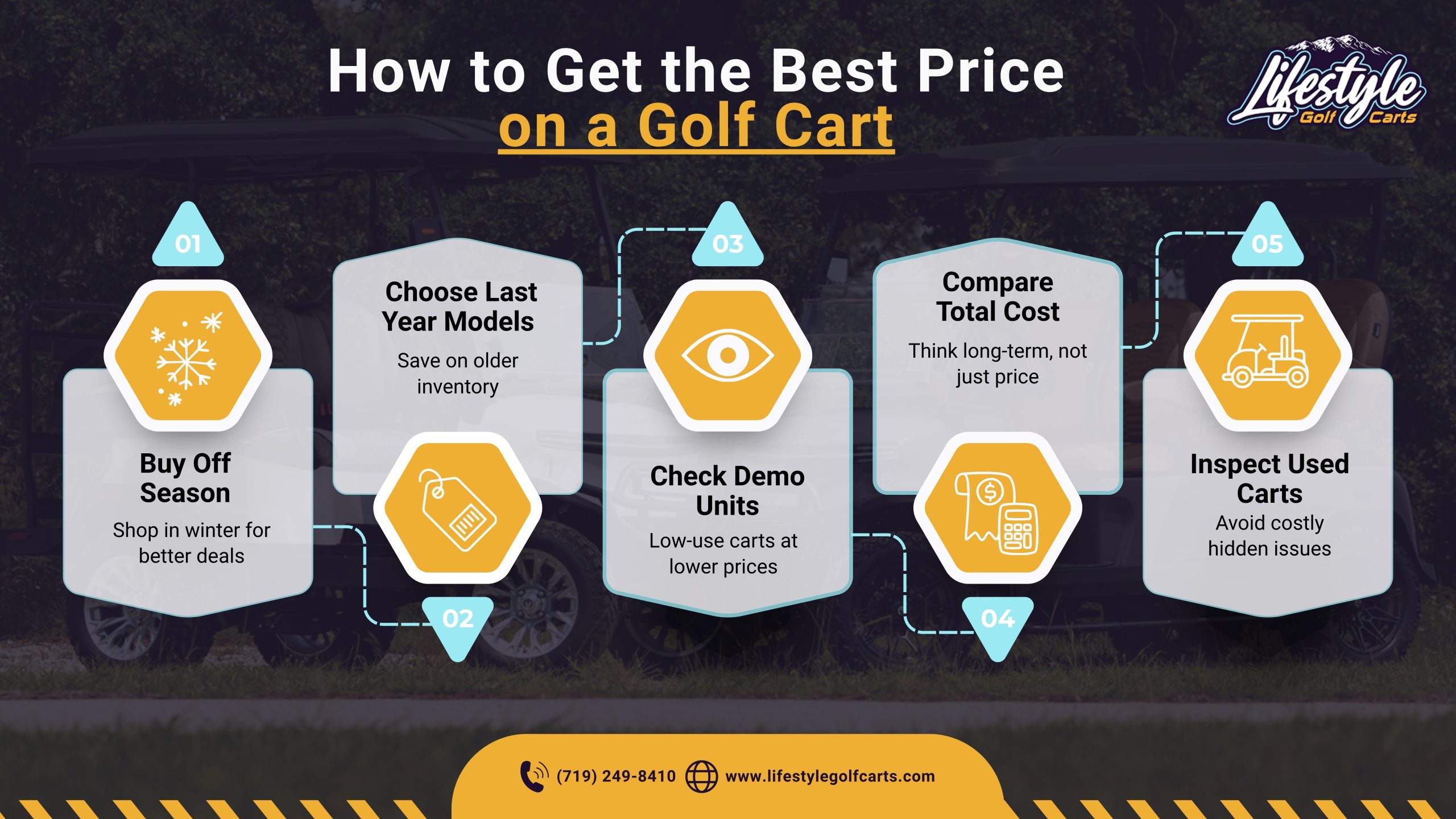
Buy in the off-season. Golf cart prices tend to dip in late fall and winter when demand drops. In cold-weather states like Colorado, dealers are more willing to negotiate from November through February. Spring and early summer? That’s peak demand, and prices reflect it.
Consider last year’s models. When new model years arrive, dealers often discount remaining previous-year inventory. The differences between model years are usually minor, cosmetic tweaks and small feature updates, but the savings can be $500 to $2,000.
Look at dealer demos and showroom models. These carts have low hours but can’t be sold as “new.” Many dealers discount them 10% to 20% off retail.
Compare total cost, not just sticker price. A cheaper gas cart might cost more over 5 years when you add up fuel, maintenance, and engine repairs. A more expensive lithium electric cart could actually be the cheaper option long-term.
Don’t skip the inspection on used carts. Spending $50 to $100 on a professional inspection before buying a used cart can save you thousands in unexpected repairs. Battery load testing alone is worth the cost.
Golf Cart Cost Comparison
Here’s a condensed view of what you can expect to spend across the main categories:
- New Gas Golf Cart (basic 4-seater): $7,500 to $10,000
- New Electric Cart, Lead-Acid (4-seater): $8,000 to $11,000
- New Electric Cart, Lithium (4-seater): $10,000 to $18,000
- New LSV/Street-Legal Cart: $12,000 to $22,000
- Used Cart, 1-3 years old: $6,000 to $11,000
- Used Cart, 4-6 years old: $4,000 to $7,500
- Used Cart, 7+ years old: $2,000 to $4,500
- Annual Maintenance (electric): $200 to $400
- Annual Maintenance (gas): $300 to $600
- Annual Insurance (street legal): $100 to $500
- Monthly Charging Cost (electric): $10 to $25
- Monthly Fuel Cost (gas): $30 to $60
Is a Golf Cart Worth the Money?
For a lot of buyers, absolutely. If you live in a golf cart-friendly community, use one for short trips around your neighborhood, or need it for work on a property, ranch, or resort, a golf cart pays for itself in convenience and fuel savings compared to driving a truck or SUV for those same short trips.
The key is matching your budget to your actual needs. Don’t overspend on a premium 6-seater with every upgrade if you’re mostly using it solo on a golf course. And don’t underspend on a cheap used cart with dying batteries if you need reliable daily transportation around a neighborhood.
Figure out how you’ll use it, set a realistic budget that includes the hidden costs we covered above, and buy from a dealer who’ll stand behind the sale with warranty support and service.
If you’re in Colorado, Lifestyle Golf Carts in Colorado Springs carries new and used inventory across multiple brands and offers financing. They’re a good starting point for comparing prices in person.