
Here’s a question most golf cart buyers don’t think about until it’s too late: do you actually need insurance for your golf cart?
The short answer depends on how and where you use it. If you drive your cart on public roads (even low-speed neighborhood streets), most states require liability insurance, just like a car. If you only use it on a golf course or your own property, insurance is usually optional, but skipping it is a gamble most owners shouldn’t take.
Golf carts aren’t toys. They weigh 800 to 1,200 pounds, carry passengers, and can reach 25 mph. Accidents happen, and without insurance, you’re personally responsible for medical bills, property damage, and legal costs.
This guide covers when golf cart insurance is required by law, what it typically costs, what different policies cover, and how to save money without cutting corners on protection.
When Is Golf Cart Insurance Required by Law?
The rules vary depending on your state and how your golf cart is classified. There are two main categories that matter:
Street Legal Golf Carts and LSVs
If your golf cart is registered as a Low Speed Vehicle (LSV) and you drive it on public roads, you’ll need insurance in almost every state. An LSV is a golf cart that meets federal safety standards (headlights, tail lights, mirrors, seatbelts, etc.) and can travel at speeds of 20 to 25 mph.
In Colorado, any LSV driven on public roads must carry the same minimum liability insurance as a regular vehicle. That means:
– $25,000 bodily injury per person
– $50,000 bodily injury per accident
– $15,000 property damage per accident
Most other states have similar requirements. If your cart is titled, registered, and driven on streets, treat it like you would any other vehicle when it comes to insurance.
Golf Course and Private Property Use
If your golf cart stays on the golf course or never leaves your private property, most states don’t require insurance. Your homeowners policy may provide some coverage, but it’s usually limited.
Here’s where it gets tricky: homeowners insurance typically covers golf carts on your property with basic liability, but coverage often caps at low amounts and might not cover medical payments for passengers or damage that happens off your property.
If you drive your cart to a neighbor’s house, take it to a local park, or use it anywhere beyond your own property line, your homeowners policy might not cover an incident. That gap in coverage is exactly where people get into trouble.
How Much Does Golf Cart Insurance Cost?
Golf cart insurance is surprisingly affordable compared to auto insurance. Here’s what you can expect to pay:
Liability-Only Coverage
A basic liability policy for a golf cart costs about $100 to $200 per year. This covers damage and injuries you cause to other people and their property. It doesn’t cover damage to your own cart.
This is the minimum you’d need for an LSV driven on public roads. It’s also the most affordable option if you’re looking for basic protection without spending a lot.
Full Coverage (Liability + Collision + Comprehensive)
Full coverage policies typically run $200 to $500 per year, depending on the value of your cart, where you live, and how you use it.
Full coverage adds collision protection (covers damage to your cart from an accident) and comprehensive coverage (covers theft, vandalism, weather damage, and other non-collision events). If you’ve spent $10,000 or more on your cart, full coverage makes sense. Paying $300 a year to protect a $15,000 investment is a pretty reasonable trade.
What Affects Golf Cart Insurance Rates
Several factors move your premium up or down:
Cart value: A $20,000 lithium electric cart costs more to insure than a $5,000 used gas cart. Higher replacement cost means higher premiums.
Usage: Street-driven carts cost more to insure than golf-course-only carts because the risk of an accident is higher on public roads.
Location: Insurance costs vary by state and even by zip code. Areas with higher accident rates or theft rates tend to have higher premiums.
Coverage limits: Higher liability limits cost more, but they also protect you better. The difference between $25,000 and $100,000 in bodily injury coverage might only be $30 to $50 more per year, and the extra protection is worth it.
Deductible: A higher deductible (the amount you pay out of pocket before insurance kicks in) lowers your premium. A $500 deductible will cost less per year than a $250 deductible.
Your driving record: Some insurers check your driving history even for golf cart policies. A clean record helps.
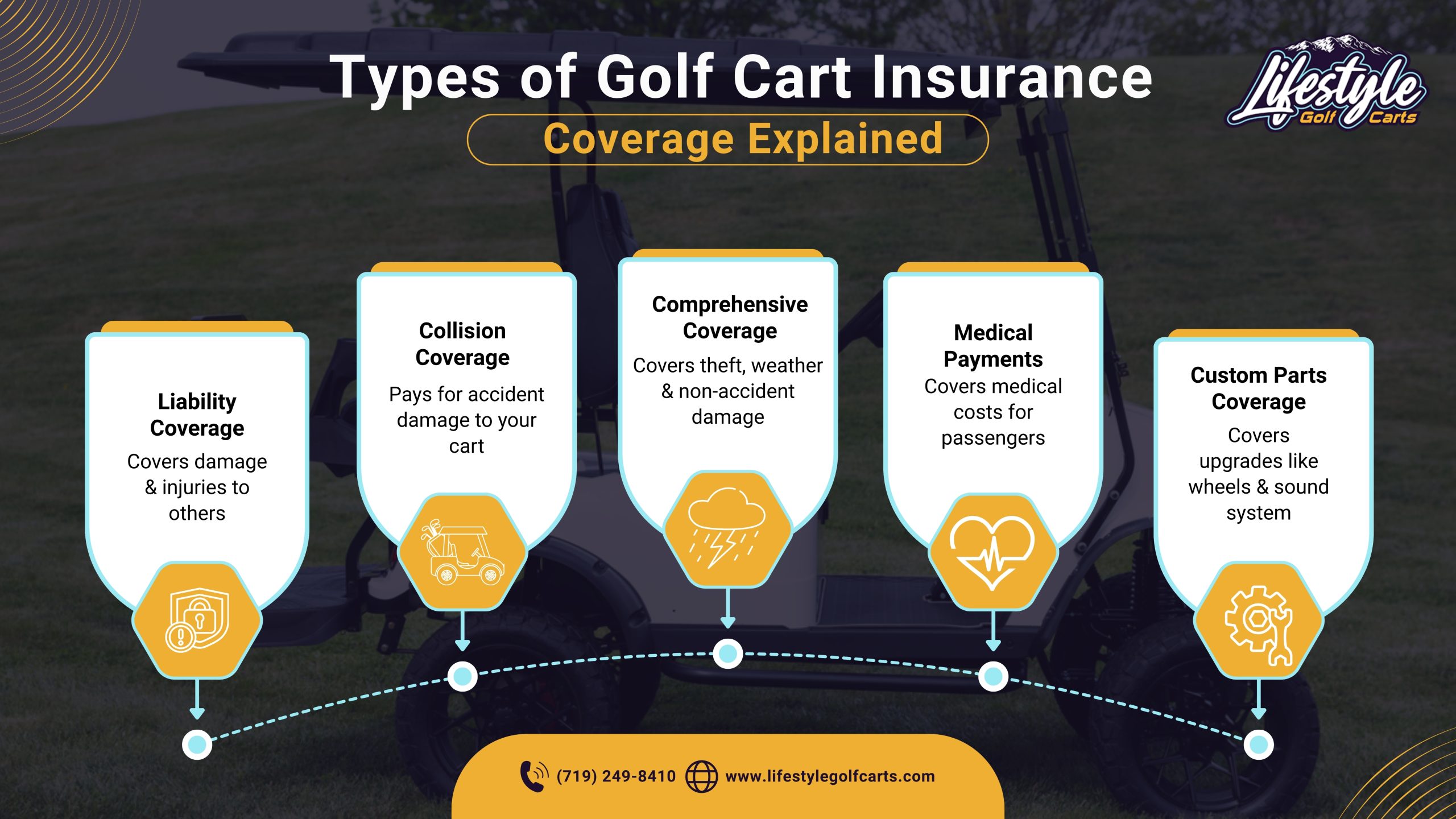
Types of Golf Cart Insurance Coverage Explained
Insurance policies use specific terms that can be confusing if you’re not familiar with them. Here’s what each type of coverage actually means in plain language:
Liability Coverage
This pays for damage and injuries you cause to other people. If you hit a mailbox, a parked car, or (worst case) a pedestrian, liability coverage handles the bills. It does not pay to fix your own cart.
Every state that requires golf cart insurance requires liability coverage at minimum. Even if your state doesn’t require it, liability coverage protects your personal assets if you’re sued after an accident.
Collision Coverage
This pays to repair or replace your golf cart if it’s damaged in an accident, regardless of who’s at fault. Hit a tree? Rolled the cart on a slope? Rear-ended another vehicle? Collision coverage takes care of your cart.
This is optional, but strongly recommended for carts worth $5,000 or more.
Comprehensive Coverage
This covers non-accident damage: theft, vandalism, fire, flooding, falling trees, hail, and similar events. In Colorado, where hailstorms and extreme weather are common, comprehensive coverage is worth considering.
Golf cart theft is more common than most people realize. Carts are easy targets because they’re often stored in open garages, carports, or driveways without locks. Comprehensive coverage protects against that risk.
Medical Payments Coverage
This pays medical expenses for you and your passengers if anyone is injured while riding in the cart, regardless of fault. This can cover emergency room visits, ambulance costs, and follow-up treatment.
Medical payments coverage is usually inexpensive (often $20 to $50 per year for $5,000 to $10,000 in coverage) and worth adding to any policy.
Uninsured/Underinsured Motorist Coverage
If you’re driving your street legal cart and get hit by someone without insurance (or without enough insurance), this coverage pays your medical bills and cart repairs. Since golf carts offer much less physical protection than cars, this coverage is especially worth having.
Custom Parts and Equipment Coverage
If you’ve added aftermarket upgrades to your cart (lift kit, custom wheels, LED lights, sound system, specialty seats), standard policies may not cover them. Custom parts coverage adds protection for your modifications, usually for an additional $20 to $75 per year.
Does Homeowners Insurance Cover Golf Carts?
This is one of the most common questions, and the answer is “maybe, but probably not enough.”
Most homeowners policies provide limited coverage for golf carts under the personal property section. This typically means:
Your homeowners insurance might cover your golf cart if it’s damaged or stolen from your property. The coverage amount is usually limited to a percentage of your personal property coverage, and there may be a specific sublimit for motorized vehicles.
Liability coverage through your homeowners policy might apply if someone is injured while riding your cart on your property. But if the accident happens off your property, coverage often doesn’t apply.
Your homeowners policy almost certainly won’t cover your golf cart if you drive it on public roads, use it commercially, or modify it beyond stock configuration.
The safest approach: call your homeowners insurance company and ask specifically what’s covered and what isn’t. Then fill any gaps with a standalone golf cart policy or an add-on to your auto insurance.
Can You Add a Golf Cart to Your Auto Insurance?
Yes, and for many owners this is the most convenient and cost-effective option.
Most major auto insurance companies (State Farm, GEICO, Progressive, Allstate, and others) allow you to add a golf cart or LSV to your existing auto policy as an additional vehicle. This usually costs less than a standalone golf cart policy because you’re bundling coverage.
Adding a golf cart to your auto policy typically costs $50 to $200 per year for liability coverage, with full coverage adding another $100 to $300 on top of that. The exact cost depends on the insurer, your cart’s value, and how you use it.
Some advantages of adding to your auto policy:
You get the same coverage types available for your car (liability, collision, comprehensive, medical payments, uninsured motorist). Your existing agent handles everything. You may qualify for multi-vehicle discounts.
One thing to watch out for: not all auto policies cover golf carts used on golf courses. If you use your cart for actual golf plus neighborhood driving, make sure both uses are covered.
Golf Cart Insurance Requirements by State
Insurance requirements vary across the country. Here’s a quick look at how some common states handle it:
Colorado: LSVs require minimum liability insurance identical to standard motor vehicles. Registration and titling required for road use. Insurance not required for golf course or private property use only.
Florida: One of the most golf-cart-friendly states. Insurance is not required for golf carts, but it is required for LSVs driven on public roads. Many communities strongly recommend coverage regardless.
Arizona: LSVs must be titled, registered, and insured like standard vehicles. Golf carts restricted to private property don’t need insurance.
California: LSVs require liability insurance. Golf carts on roads with speed limits under 25 mph may be exempt from insurance in some local jurisdictions, but it’s still recommended.
Texas: No state-level insurance requirement for golf carts, but LSVs operated on public roads need liability coverage. Local ordinances may add requirements.
South Carolina: Requires liability insurance for golf carts driven on public roads, even if they’re not classified as LSVs. This is unusual compared to most states.
Your best move: check your state’s DMV website or call a local insurance agent to confirm the exact requirements for your situation.
How to Save Money on Golf Cart Insurance
Insurance is necessary, but that doesn’t mean you should overpay. Here are some ways to keep costs down:
Bundle with your auto or homeowners policy. Most insurers offer discounts when you combine policies. Adding a golf cart to an existing auto policy is almost always cheaper than buying a standalone policy.
Raise your deductible. Going from a $250 to a $500 deductible can reduce your annual premium by 10% to 20%. Just make sure you can afford the deductible if you need to file a claim.
Ask about discounts. Some insurers offer discounts for safety features (seatbelts, lights, mirrors), storage in a locked garage, anti-theft devices, or completion of a safety course.
Shop around. Rates vary widely between companies. Get quotes from at least 3 insurers. Online quote tools make this quick.
Only buy what you need. If your cart is worth $3,000 and you’d replace it out of pocket, you might skip collision and comprehensive coverage. But if your cart is worth $10,000+, full coverage usually makes financial sense.
Review annually. As your cart ages and depreciates, you may be able to reduce coverage levels and save money. A 10-year-old cart doesn’t need the same coverage as a brand new one.
What to Do If Your Golf Cart Is in an Accident
If you’re involved in an accident while driving your golf cart, here’s what you should do:
Check for injuries first. Call 911 if anyone is hurt.
If the accident involves another vehicle or property damage, exchange information with the other party and take photos of the damage, the location, and any relevant details.
File a police report if the accident happened on a public road or involves injuries. This creates an official record that your insurance company will need.
Contact your insurance company as soon as possible. Most policies require prompt reporting of incidents. Delays can complicate or even jeopardize your claim.
Keep records of everything: repair estimates, medical bills, rental costs, and any communication with the other party’s insurance company.
Street Legal Golf Carts and Insurance in Colorado
Since Lifestyle Golf Carts is based in Colorado Springs, here’s what Colorado buyers specifically need to know about LSV insurance:
Colorado treats LSVs the same as motor vehicles for insurance purposes. If your golf cart is registered and titled as an LSV, you must carry minimum liability coverage. This applies whether you drive it in a gated community, on neighborhood streets, or on any public road with a speed limit of 35 mph or less.
Many Colorado golf cart owners also add comprehensive coverage because of the state’s hail and severe weather exposure. A single hailstorm can cause hundreds or thousands of dollars in damage to a golf cart’s body, roof, and windshield.
If you’re buying a new or used golf cart from a dealer like Lifestyle Golf Carts, ask about insurance before you take delivery. Some dealers can connect you with insurers who specialize in golf cart and LSV policies and may offer competitive group rates.
Having the right coverage in place before your first ride on a public road isn’t just a legal requirement. It’s the smart thing to do.